Wednesday, April 29, 2026
Issue 626: In the Bear’s Den with M101, M81, M82, M97, and M108
 |
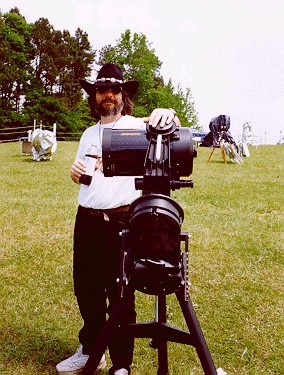
| Little Debbie's new light shroud/dew shield has made a big difference! |
If only it were that simple. At first it looked like
it might be a good galaxy season this year. Clear skies had been the rule as
winter transitioned to spring. Weeks went by with nary a drop of rain. Hell,
the big topic with the OMs and YLs at Breakfast with the Hams at the Whataburger
turned from scuttlebutt about the latest DXpedition to, “When are we gonna get
some rain?!”
Of course, that didn’t last. Just as the old Moon
waned and the spring stars climbed higher…yep, you guessed it. Clouds and
thunderstorms returned to Possum Swamp. I did get a couple of decent if not
quite perfect evenings, though, and thought I'd better get back on Messier Project Road while I could; spring is absolutely flying by.
I didn’t have a lot of dark-of-the-Moon nights, but I was
able to visit Ursa Major’s wonders, M101, M81, M82, M108, and M97 on a couple of passable, if hazy, evenings. At
least it was warm enough that your aged Uncle didn’t flee inside till 10pm. I
did take some pictures, but I concentrated on visual observing when I could
(not with M101 from my suburban backyard, of course). Said visual observing was
enhanced by my latest project. I had done what I should have done a long time ago
and rigged up a shroud/dew shield for my 6-inch SkyWatcher collapsible
Dobsonian.
It is a good telescope, but the slightest bit of ambient
light spoils the party. I’d tried various dodges, like wrapping fabric
around the truss (difficult because the wee scope only has two truss tubes). Finally, I hit upon the
idea of using thin, black craft foam. And placing it inside the truss
tubes.
After considerable cussing and mistakes (your old Uncle is
an absolute menace with scissors) I was done. The plastic shroud moves with the
tubes and upper cage (if you can call it that) and collapses with them. It has offered
major improvement to field darkness—even when I thought stray light wasn’t
getting into the system, it evidently was. If you face the same problem, a nice
feller on the Internet thought of the idea before I did and has a good YouTube
video on making a shroud for SkyWatcher’s small collapsible-tube Dobs. Just
Google.
Anyhoo, let’s poke around in the bear’s den a bit…. We’ll
be moving on from John Mallas and The Messier Album for tonight, and I
at first thought I’d see what Scotty had to say about these deep sky objects.
But then I changed my mind. Let’s see what that other dean of deep
sky observers, Sue French, thinks of tonight’s DSOs.
M101

Let’s do the just-the-facts stuff before we go further with
observing. M101, NGC 5457, was like many of the other “Messier” objects,
discovered by Pierre Méchain, who pulled it out of a dark French sky on
27 March 1781. Stats? This is a Hubble SAB type spiral galaxy. While it has
the not-too-intimidating magnitude of 7.9, remember, that is how bright it
would be if this large (28’48” x 26’54”) object were shrunken down to stellar
size. As is, at near 30’ across it is challenging from poorer observing
sites. Some rate M74 as even more difficult, but I disagree. M74 can be
seen in drier and less hazy autumn skies. M101 is tough.
So, how well has your
silly old Uncle been able to see it? From a dark site, it is not much of a
problem. You want a telescope/ocular combination that places enough empty field
around the galaxy to provide some contrast, but given that, it’s often easy. It
doesn’t even take a big scope. Many years ago, the Pinwheel was spectacular in my old Ultima C8 from the pitch-black
skies of French Camp, Mississippi and the Mid South Star Gaze, showing plenty
of spiral detail. From the clear skies of West Virginia and Spruce Knob
Mountain at the Almost Heaven Star Party? Like shooting fish in the
proverbial barrel with 10x50 binoculars.
That’s out in the dark. How about the backyard? You must
be satisfied just to have seen a trace. I was determined to observe the
Pinwheel for my Urban Astronomer’s Guide,
but nothing I tried worked from old Chaos Manor South’s urban backyard. I
finally took my (focal reduced) C11 to the public Schools’ Environmental
Studies Center in the suburbs. I could see it then, yeah… As a slight
(and I do mean slight) brightening at the field center. I was able
to replicate that observation with an 8-inch f/5 Newtonian.
At the new Chaos Manor South with the 6-inch f/5 SkyWatcher
(who says her name is “Debbie”)? I simply have not been able to do it so far. Maybe
I’ll wait for a particularly dry evening (“dry” is as important as “dark” for
this one, just as with M74). I did want to see it somehow, though, so I
gave little Suzie, the SeeStar S50, a shot. Easy-peasy. Even with just 45
minutes of exposure (there was enough light pollution-scattering haze that I
was loath to go longer) the Pinwheel looks good as a bright-backyard snapshot.
So, what does Sue French think of the Pinwheel in her
(excellent) book, Deep Sky Wonders? From a Dark site with her
10-inch, Sue calls the galaxy, “[A] grand Catharine-wheel firework shedding multiple
spiral arms. Two arms north of the core
unwrap to the west.” While Sue’s views were like what I’ve seen with 8 –
11-inch instruments from dark locations, it’s clear she is a better observer
than I am and picked up more spiral structure and more easily than I have. Bottom
line? If you want to see spiral arms, get thee to a dark site (or turn a
smartscope loose on it).
M82

We’ll get to that in a minute, but let’s bone up on the
Cigar’s background. M82 and M81 were first seen by Johann Bode in 1774. However,
in 1779, Pierre Méchain independently
rediscovered both Ms and reported them
to his buddy, Chuck. So, I guess you can say Pierre is batting a thousand tonight.
This strange galaxy’s specs are impressive. It shines at
magnitude 8.4—and looks it. M82, NGC 3034, is only 11’18” x 4’12” so its
surface brightness remains high. It is classified as an irregular galaxy and is
in a close to edge-on orientation to us. If you must observe the deep sky from
the suburbs, edge-on galaxies are, you’ll find, some of the easiest to see (if
not always easy). Anyhow, a look at M82 with even a small scope hints that
something bad has happened to it. That was no doubt a close encounter
with M81 a long, long time ago.
Also a long time ago, if on a human scale, I was doing a
series of columns, “From City Lights to Deep Space,” for my local astronomy
club’s newsletter, the pieces that later went on to form The Urban Astronomer’s
Guide. I had my share of failures with deep sky objects from my urban back forty.
Mostly when I was working at the low end of the aperture scale, using my
time-honored 4-inch Edmund Scientific Palomar Junior reflector to see what I
could dig out of urban skies. M81 admittedly wasn’t much—I’ve never seen its
spiral structure at a compromised site with any scope—but M82 was a different
story. The little cigar was bright and crisscrossed with a dark lane or three.
To go beyond that, larger aperture and a dark sky are required.
Seeing the red gas plumes being emitted from the core? As far as I know, you
need a camera, but you don’t necessarily need long exposures. I was able to see
the “explosion” part of this exploding cigar with ease from the Chiefland
Astronomy Village with my Mallincam Extreme deep sky video camera in 15
second shots. A hint of that is visible in Suzie Q's shot here if you zoom in. Maybe I should give the girl more time on the Cigar some night.
Visually today, from the better skies of the new Chaos Manor South
with a little more aperture? In 6-inch Little Debbie (she hates it when I call
her that, “What am I? A cupcake, Rod? Don’t answer that!”) the
view isn’t worlds different from what it was in my Pal Junior. The disk
of is brighter, though, and the dark lanes and patches easier. With her 10-inch, Sue goes beyond what I’ve seen easily in similar aperture instruments, “This
scope revealed the tapered form of M82…with three main dark patches. A broad
one east of the galaxy’s center cuts across M82, with the brightest portion of
the galaxy lying to its east.” Suzie turned in a nice portrait of the pair. The usual problem was present, though: M82 is easy to OVERexpose.
There is a lot to see in M81 and M82, but you won’t
see it with quick visits. Study, at least half an hour of study, on each is not
too much. That will pay off, though. While you may never be in Sue French’s
league as an observer, you will find that every time you visit you see just a
little more.
M97

The Owl Nebula is, of course, a planetary nebula, the corpse
of a solar mass-range star that has shed its outer layers and is now a fading
white dwarf (that central star is a dim magnitude 16). At magnitude 9.9, this
medium-sized (3’24” x 3’18”) planetary is not a challenge for even marginally experienced
observers.
History-wise, M97 is another catch by Messier bestie Méchain, who spotted it on 16 February 1787. There’s no mention of dark spots by him,
and evidently the eyes were first seen (or at least recorded) and the “owl”
name given the nebula by the Earl of Rosse who observed it with his 72 inch
reflector.
The night I set out to catch an Owl in 1966 was one of the
Saturday evening observing runs of our kid astronomy club, The Backyard Astronomy Society. Frequent naysayer Wayne Lee laughed, proclaiming I didn’t have a
dog’s chance in hell of seeing such a faint object from his mama’s
backyard. But there it was, if barely, No eyes, but the faint puffball of the
planetary’s disk was plain in my ½ inch Ramsden eyepiece.
The secret to seeing the eyes in these latter days? They
are not always easy, but an OIII filter can make them easier. While it might sound like an “averted imagination” observation with Little Debbie from the backyard of today's Chaos Manor South, I'm convinced I've spotted them. Maybe. The 6-inch showed the disk of the nebula
without difficulty, however, if with a filter. Like many planetaries that were
considered challenging 40 or 50 years ago, the OIII, a filter that enhances the
Oxygen III emissions of planetary nebulae, has made all the difference in the
world.
This being a rather small object for Suzie, the shot here
was done last spring with Evie, the 4-inch Evolution smartscope. I was just
learning to use the telescope, so the brief exposure wasn’t anything to write
home about, but the eyes and the triangle of dim stars hidden in the nebulosity
are easy to see in my snapshot. In 10-inch Zelda, the eyes are often visible from the backyard and
always from a somewhat darker site I occasionally use.
Ms. French also turned her 10-inch reflector to M97. Ace
observer that she is, she had no trouble at all with the dark patches. She notes
that the nebula appears slightly oval. It is (very slightly), but I don’t
think I have ever noticed that. Maybe I’m always too fixated on the eyes to get
the bigger picture.
M108

M108 is an SB galaxy that shines at magnitude 10 and
subtends 8’42” x 2’12”. As with the big Cigar, being edge-on makes it easy(er)
to see with small telescopes from bright backyards. Technically, this galaxy
was another Pierre Méchain discovery on 19 February 1781, but it was “lost” and subsequently recovered by Messier on March
24 of that same year.
In these latter days, knowing what M108 is, a dusty, not
exploding, galaxy, that’s how I tend to see it. Truthfully, though, in a 6-inch
at medium power, it still retains that M82 look for me. Even Suzie’s brief
exposure, however, hints at its true nature. In the French 10-inch? Sue
mentions, “mottled,” which to me hints at its M82 guise. But she goes on to
call it “patchy,” which is an indication of its true nature. She doesn’t
mention it looking anything like M82, either. Am I the only one who sees it
that way (at times)?
And that is a wrap, campers. I know this has been a long one
for “only” four objects. But they are terrific ones; there is just so much to
see in this old bear’s den. If you’ve clear skies, get out there and scan the
dipper while you can! Me? Little Debbie is safely resting in the Sunroom, and I am
sitting in the den with the cats, drinking cold 807s, and supposedly watching
YouTube, but actually still contemplating the Realm of the Great Bear.
The Bottom Line:
21 down 89 to go.
Next Time? Canes and Coma…if the weather
gods allow it…